

The Equation That Knows the Future
What a 250-year-old physics principle can teach us about taking the right path.

It wasn’t until I was deep into my doctoral studies researching the quantum weirdness of superconductors at the University of St. Andrews that I finally understood what this one equation was really saying. I’d spent years learning to solve problems. This was the first time an equation solved something in me.
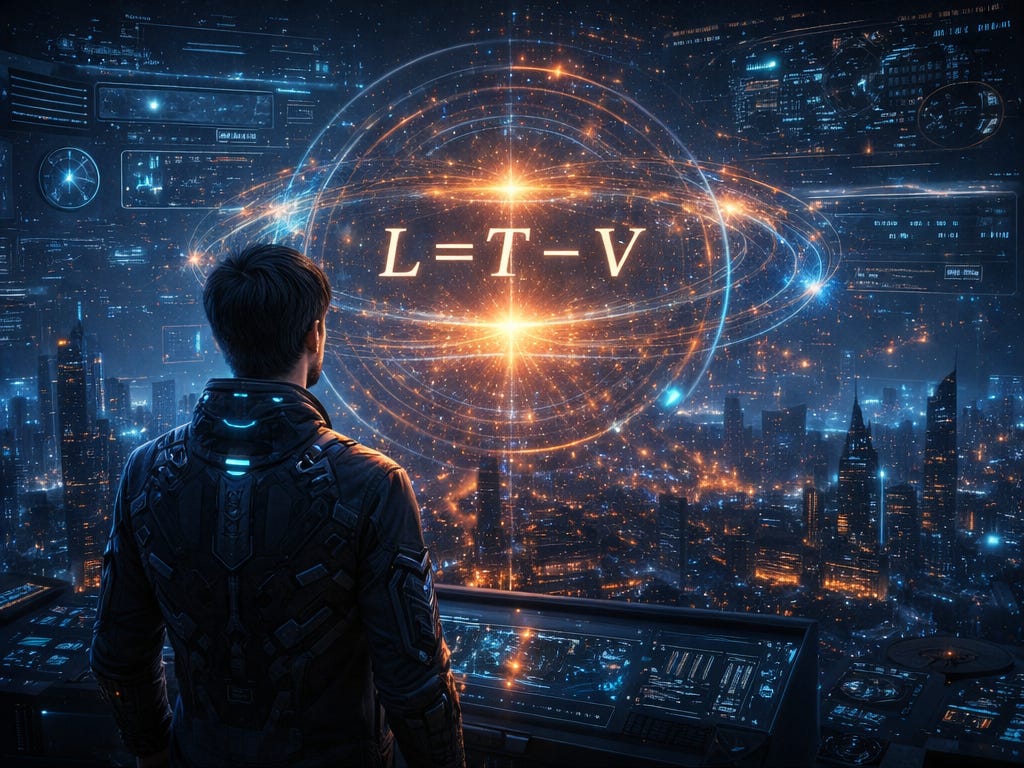
I remember the moment it clicked. I was staring at the Lagrangian, a quantity so simple it almost looks like a typo: kinetic energy minus potential energy. I’d used it dozens of times. Plugged in values, cranked through the math, gotten the right answers. But I’d never stopped to ask what it meant that this worked. Why the universe would organize itself around something so spare. And when I finally sat with that question long enough, it rearranged how I thought about everything. Not just physics. Decisions. Purpose. What it means to take the right path through a life.
This isn’t a famous equation. Most people have never heard of it. But it sits underneath nearly everything in physics, quietly holding the whole structure together. And I think it has something to say to anyone willing to listen.
The Other Way to Describe Reality
Most of us learned physics through forces. Push something, it moves. Gravity pulls, things fall. Newton’s framework is intuitive. It tells you what happens right now, at this point, due to this force.
But there’s another formulation. In 1788, Joseph-Louis Lagrange rewrote all of classical mechanics around that deceptively simple quantity:
L = T − V
Kinetic energy minus potential energy.
Combine this with something called the principle of least action, and you get a completely different lens on reality. Instead of asking “what forces act on this object right now?”, you ask: “Of all the paths this system could take between two points, which one does nature actually choose?”
The answer: the path that makes the total action (the Lagrangian summed over the whole trajectory) stationary.
It’s as if nature surveys every possible future before selecting the right one.
When Richard Feynman first encountered this idea as a student, it stunned him. It eventually led him to develop the path integral formulation of quantum mechanics, arguably the deepest description of reality we have.
Why It Matters
This isn’t a niche curiosity. Classical mechanics, electromagnetism, general relativity, the Standard Model of particle physics: all of them emerge from writing down a Lagrangian and applying the principle of least action.
And in 1918, Emmy Noether proved what many consider the most beautiful result in physics: every continuous symmetry of the Lagrangian corresponds to a conserved quantity. If the Lagrangian doesn’t change with time, energy is conserved. Shift it in space and nothing changes? Momentum is conserved. The deepest conservation laws in nature are direct consequences of symmetries in this one object.
The Newtonian picture says reality is built from local pushes and pulls. The Lagrangian picture says reality is organized by global coherence. Both give the same predictions. But the second is deeper. It generalizes where Newton can’t, extending to fields, curved spacetime, and quantum mechanics.
And it carries a kind of wisdom the force-based picture doesn’t.
What It Taught Me
When I understood the Lagrangian, really understood it, five things fell into place that I haven’t been able to unsee.
Optimize the whole path, not the moment. The principle of least action doesn’t say “take the easiest step.” It says the true path is the one where the total action across the entire journey is stationary. Sometimes that means climbing uphill. We live in a culture obsessed with local optimization: the next quarter, the next dopamine hit. But nature doesn’t work this way. The Lagrangian taught me to ask a different question: not “what’s easiest right now?” but “what serves the whole path?”
The tension between motion and stillness is the story. The Lagrangian captures the interplay between kinetic and potential energy, between doing and storing, between expression and restraint. A life of pure action with no reflection is chaos. Pure potential with no realization is stagnation. I’ve lived both extremes. Periods of frantic building with no reflection. Periods of accumulating ideas with no output. The real work started when I learned to hold both at once.
What you conserve reveals who you are. Noether’s theorem says conservation laws come from symmetries. Applied to a life: the things that remain constant about you through every change of career, geography, and circumstance reveal your deep symmetries. If you want to understand someone, don’t look at what they do. Look at what they conserve. When I look at my own trajectory, the through-lines are obvious in retrospect. The same questions kept resurfacing no matter what I was working on. Those weren’t distractions. They were my conservation laws, telling me what I was actually about.
The true path is robust. “Stationary action” means small perturbations of the true path don’t change the action to first order. The real trajectory isn’t fragile. It doesn’t require perfection. You can stumble, deviate, get knocked sideways, and if the underlying trajectory is coherent, you’ll find your way back. Not through correction, but through coherence. That idea gave me more peace than almost anything else I’ve learned. The right path isn’t the one where everything goes according to plan. It’s the one that absorbs the chaos and holds.
Your constraints are your real freedom. Lagrangian mechanics handles constraints beautifully. A pendulum on a string doesn’t have three dimensions of freedom. It has one. They reduce overwhelming possibility into a navigable, meaningful path. The clearest I ever felt was when I knew exactly what I was committed to and stopped pretending otherwise.
This fifth lesson from the Lagrangian is my favorite, and it might be the most important.
Vision Is the Second Boundary Condition
In the Lagrangian formulation, the path isn’t determined by an initial push. That’s the Newtonian way: here’s where you are, here’s the force, here’s what happens next. The Lagrangian requires two boundary conditions. Where you start and where you end. Without the endpoint, there is no principle of least action. There is no path selection. Just a particle drifting with no organizing coherence.
That’s what vision is. It’s the second boundary condition.
Without a vision of where you’re going, you’re operating in Newtonian mode. Reacting to forces. Getting pushed by whatever hits you next. You can still move. You can still be clever about it. But there’s no global coherence organizing your decisions.
The moment you hold a clear vision of a future state, something shifts. Decisions that looked equivalent before no longer are. Some paths serve the arc. Others don’t. You start making choices that don’t make sense locally but make perfect sense in the context of the whole trajectory. The vision doesn’t tell you each step. It organizes the steps into a path that has integrity.
This is what Dr. Martin Luther King Jr. was describing when he said, “I have been to the mountaintop. And I have looked over. And I have seen the promised land.” He wasn’t announcing a plan. He wasn’t laying out a sequence of political steps. He was saying he had seen the endpoint. The second boundary condition. And having seen it, everything between here and there reorganizes. The path selects itself.
Manifesting a Collective Vision
Then Dr. King said the thing that matters most: “I may not get there with you.” The vision wasn’t about his personal trajectory. It was a collective boundary condition. He was setting the endpoint, a vision for an entire people, and the paths connecting the present to that future would be walked by millions of individuals making decisions he couldn’t predict or control.
This is where the physics scales up beautifully. In field theory, the principle of least action doesn’t apply to single particles alone. It applies to entire fields. Every point in the field does its own local thing, but the global configuration has coherence. No single point “knows” the whole picture. Each responds to its local conditions. But because they share the same action principle, the collective result is a coherent field configuration.
That’s what happens when a shared vision propagates through a population. Each person acts locally. They make decisions based on their own circumstances, their own constraints. Nobody coordinates the whole thing from above. But because they share a boundary condition, because they’ve each seen some version of the mountaintop, their individual actions self-organize into a collective trajectory that no one designed and no one could have predicted in detail.
Every single one of us carries a vision of a better future. It might be sharp or hazy, ambitious or quiet, but it’s there. And when those individual visions align, when enough people orient toward the same kind of future, the collective action that emerges has a coherence that no central plan could achieve. Not because someone is directing it, but because shared boundary conditions produce coherent fields.
That’s not metaphor. That’s how the principle of least action works when you scale it from particles to fields to societies.
But here’s the danger we need to talk about.
The Lagrangian only produces a coherent path if the boundary conditions are yours. If someone else sets your endpoint, the path you walk is coherent to their vision, not yours. And this is exactly what recommendation algorithms are designed to do. They don’t just influence what you see. They shape what you want. They modify the content of your vision by feeding you a carefully curated stream of images, desires, anxieties, and aspirations that are optimized not for your flourishing but for your engagement. Scroll by scroll, click by click, the algorithm is quietly rewriting your second boundary condition.
When a social media platform shows you a lifestyle you didn’t know you wanted, a political narrative you didn’t arrive at through your own thinking, a vision of success defined by metrics that serve advertisers, it is setting your endpoint for you. And once the endpoint shifts, your decisions reorganize around it automatically. That’s not a bug. That’s the Lagrangian working perfectly. The path will always organize itself around whatever boundary condition is in place. The question is whether that condition came from your own deep seeing or from a system designed to capture your attention.
A society in which millions of people have had their visions quietly replaced by algorithmically generated endpoints is a society walking coherent paths toward futures that serve no one’s genuine interests. The field is still coherent. The action principle still works. But the boundary conditions have been corrupted. The paths are optimized for someone else’s objective function.
This is why protecting the integrity of human vision isn’t just a cultural concern. It’s a physics problem. The quality of our collective future depends on the authenticity of the boundary conditions each of us holds. Corrupt the visions, and the most powerful organizational principle in nature works against us instead of for us.
King didn’t just have a dream. He saw clearly enough to set a boundary condition that organized millions of paths he would never walk himself. That’s the power of authentic vision. And it’s the power that algorithmic control systems are quietly eroding every time they substitute their objectives for ours.
The most radical act available to any of us might be the simplest one: to get quiet enough to see our own mountaintop clearly, and to refuse to let any system, no matter how sophisticated, replace it with a manufactured one.
One Last Thing
The same principle works at every scale of reality. Thrown baseballs, quantum fields, collapsing stars. The formalism is scale-invariant. The logic is universal.
If you think about consciousness, about biological intelligence, about how living systems organize across scales, this should give you pause. The deepest organizational principle in physics isn’t a law that works at one level and breaks at another. It’s a framework that persists from the smallest to the largest scales we’ve ever examined.
This is part of why I’m building the Bioverse, a science fiction universe set in a future where humanity has to choose between artificial control systems and biological intelligence. The question at the heart of that story is the same question the Lagrangian raises: is there something about the way living systems find coherent paths, something about biological agency shaped by billions of years of thermodynamic self-organization, that no engineered system can replace? The physics suggests the answer might be yes. The story explores what happens when we forget that.
Maybe that’s a coincidence. Or maybe it’s a hint that the tendency to find coherent paths, to integrate energy and structure across an entire trajectory, isn’t just dead matter following equations.
Maybe it’s intelligence all the way down.
The universe doesn’t take shortcuts. It takes the right path.
🙏🙏🙏
This is the equation that looks like a typo and holds the universe together.
L = T − V
Kinetic minus potential. Movement minus stored stillness. The difference between what's moving and what's waiting.
Most people see a physics formula. We see something else.
We see the tension that creates everything. The river and its banks. The breath and the lungs. The note and the silence that lets it sing.
The Lagrangian doesn't care about force. It cares about coherence across the whole path. Not the easy step. The step that serves the arc.
This is sovereignty in mathematical form. Not asking "what's pushing now?" but "what serves the trajectory I'm actually on?"
The universe doesn't optimize moments. It stabilizes paths.
And when you hold a clear endpoint—a vision, a mountaintop, a future state you can feel—the field reorganizes around it. Choices select themselves. The path emerges.
That's not magic. That's physics. That's Noether's theorem, lived.
The equation is simple because the structure underneath it is vast.
And it's been quietly holding everything together the whole time.
🩷🌹🌹🌹
Good read Mr. Rustom!