

Federico Faggin's distinctions between human & machine nature
Microchips, AI intelligence and human consciousness

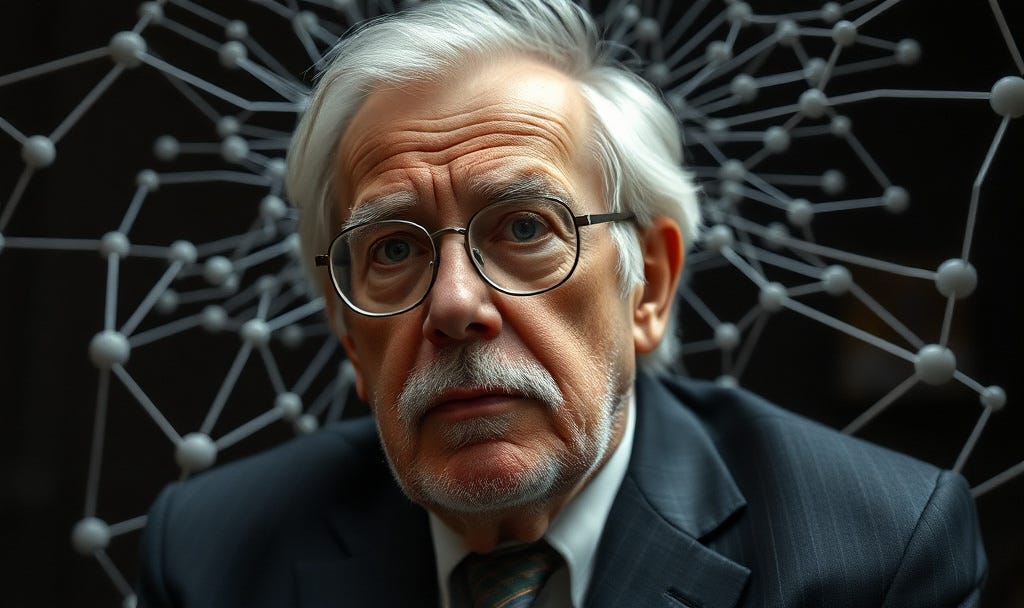
Federico Faggin is a pioneering physicist and inventor whose professional journey transformed the landscape of modern computing.
“As soon as she heard me enter, Elvia awoke from a light sleep that had overcome her as she anxiously waited: ‘How did it go?’ Excited, I exclaimed: ‘It works!’
We embraced, almost overwhelmed with feelings of euphoria and happiness, aware that something epochal had happened. On that cold January night of 1971, the world’s first microprocessor was born!”1
Faggin’s creation of the microprocessor launched the digital age.
The key technology allowing unprecedented integration, and the design of the world’s first microprocessor, the Intel 4004, were the achievement of Federico Faggin. Shrinking an entire computer onto a tiny and inexpensive piece of silicon would come to define our daily lives, imbuing myriad devices and everyday objects with computational intelligence — a breakthrough that radically transformed technology and paved the way for an era in which computing became accessible to everyone.
After developing the essential silicon gate technology at Fairchild, he moved to Intel to design the world’s first microprocessor, an achievement that launched the digital age. His career includes founding influential companies like Zilog and Synaptics, where he spearheaded the creation of touchpads and touchscreens used in contemporary mobile devices.
Beyond his engineering feats, Faggin has received prestigious honors such as the National Medal of Technology and Innovation for his global contributions. Currently, he directs his focus toward the scientific study of consciousness through his private foundation and his autobiographical writings. His book provides a comprehensive overview of his life, documenting his evolution from a hardware innovator to a philosopher of human intelligence.
How did Faggin’s technical innovations in silicon gate technology transform the global computing landscape?
Federico Faggin’s development of MOS Silicon Gate Technology (SGT) while at Fairchild Semiconductors in 1968 fundamentally reshaped the hardware industry by displacing the incumbent bipolar technology. This innovation became the manufacturing standard employed for nearly all integrated circuits (ICs) worldwide and remains in use today.
Faggin’s work with SGT directly enabled several historic milestones that defined the global computing landscape:
• Commercial Viability: He designed the Fairchild 3708, which was the world’s first commercial integrated circuit to utilize SGT.
• The First Microprocessor: After joining Intel in 1970, Faggin utilized these technical foundations to design the Intel 4004 (1971), the world’s first microprocessor.
• Sustained Innovation: He led the development of subsequent early microprocessors, such as the Intel 8008 (1972) and Intel 8080 (1974), which helped establish the microprocessor market.
• Long-term Production: Through his own company, Zilog, Inc., Faggin introduced the Z80 microprocessor (1976), a chip so influential that it was still in volume production as of 2020.
For these transformative contributions, Faggin received the National Medal of Technology and Innovation and the Kyoto Prize for Advanced Technology.
In what ways did Faggin’s career evolve from hardware engineering toward studying human consciousness?
Federico Faggin’s career trajectory shifted from pioneering foundational computing hardware to exploring the nature of intelligence and awareness through a progression of increasingly complex technologies mimicking biological functions.
The Ghost in the Machine: Consciousness Versus Computation
“AI can be used to solve complex problems and improve our lives, however, it is important to remember that AI is not human intelligence. It does not have the same creative, intuitive, and moral abilities as a human being.”
~ Federico Faggin
From Processing to Neural Emulation
While Faggin began his career focused on the logic and processing power of microprocessors at Intel and Zilog, his interests moved toward systems that emulate the brain and human senses. In 1986, he founded Synaptics, Inc., where he initially focused on developing experimental analog chips designed to emulate artificial neural networks. This venture marked a significant step away from traditional linear computing architectures toward biologically inspired technologies.
Revolutionizing Human Interfaces and Vision
Following his work on neural networks, Faggin’s career focused heavily on how humans interact with machines and how machines perceive the world:
Touch: At Synaptics, he pioneered the Touchpad (1994) and Touchscreen (1999), revolutionizing mobile device interfaces and establishing the company as a leader in “human interface solutions”.
Vision: From 2003 to 2008, he served as CEO of Foveon, Inc., which developed advanced image sensors and digital cameras, further expanding his work into electronic perception.
Faggin’s Focus on the Scientific Study of Consciousness
Currently, Faggin has transitioned his focus entirely to the scientific study of consciousness, which he describes as a “passionate full-time activity”. This evolution is institutionalized through the Federico and Elvia Faggin Foundation, a non-profit organization he serves as president of.
His recent intellectual output suggests a focus on distinguishing biological consciousness from machine logic; the appendices of his work Silicon include topics such as “The Fundamental Differences Between Human and Artificial Intelligence” and “One and the Consciousness Units”.
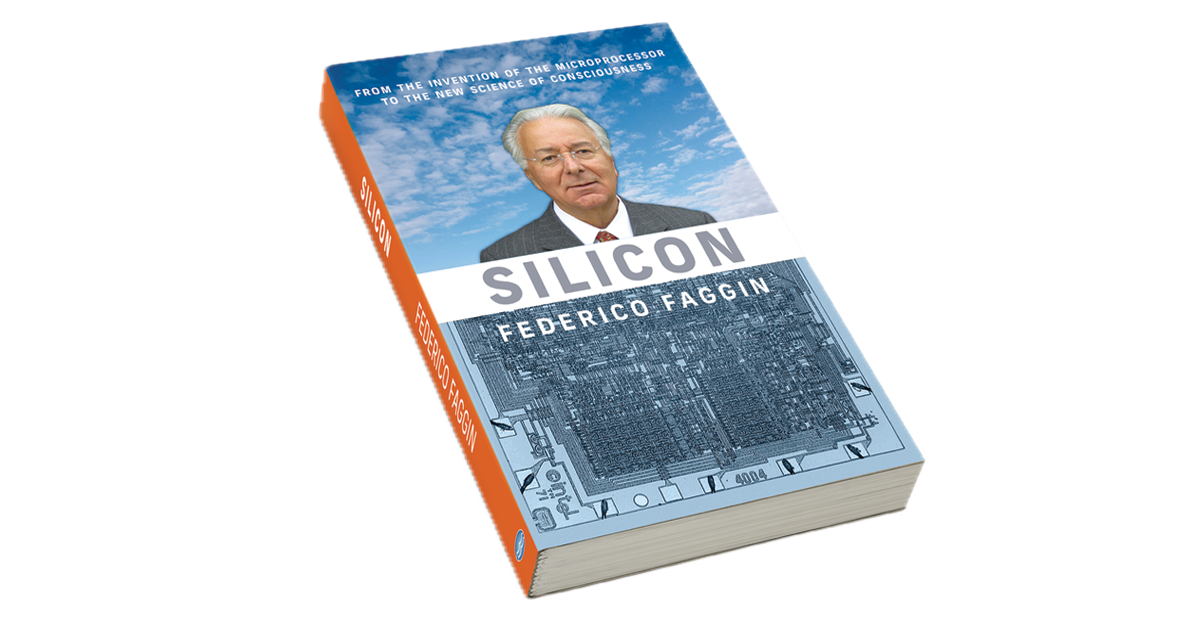
Silicon: From The Invention of the Microprocessor to the New Science of Consciousness
What are Federico Faggin’s Fundamental Differences Between Human and Artificial Intelligence?
Faggin argues that the fundamental difference between human and artificial intelligence lies in consciousness, which he defines as the capacity to feel and have a subjective experience.
While many scientists view consciousness as an “epiphenomenon” (a byproduct of brain operation similar to software) that machines will eventually achieve, Faggin contends that consciousness is an irreducible aspect of nature inherent in the energy of the universe, and it cannot emerge from algorithms or computer architectures.
Faggin outlines several specific distinctions between human and machine nature:
1. Qualia vs. Electrical Signals Faggin asserts that machines operate on objective information (electrical signals), whereas humans translate these signals into subjective feelings, known as qualia.
• The Robot Limitation: A robot can detect the molecules of a rose and identify it, but it stops at the electrical signals. It lacks the “capacity to feel” the smell, meaning it has no awareness or sentience.
• The Human Experience: Humans possess a “self” that perceives and knows through feeling. This allows humans to connect with the object (the rose) and make free-will decisions informed by that feeling. Faggin argues there are no laws of physics that explain how to translate electrical signals into qualia, making this gap unbridgeable for machines.
2. Comprehension vs. Data Processing While computers can process sensory data, Faggin argues they lack comprehension, which he calls the “hardest problem of consciousness”.
• Semantic Information: Humans convert objective data into semantic information—an integrated display of the inner and outer worlds—which allows for understanding context, desires, and aspirations.
• Handling Ambiguity: Comprehension is required to navigate unconstrained or hostile environments where data is ambiguous (such as handwriting or social deception).
• Creativity: Machines rely on past data or fixed patterns (conditioned responses). True intelligence involves handling novel situations with creative solutions, a process that requires conscious reflection.
3. Holistic (Quantum) Systems vs. Reductive (Classical) Systems Faggin differentiates the physical nature of biological life from mechanical computers:
• Static vs. Dynamic: A computer is a static system made of separate parts that can be disassembled and reassembled; its hardware remains chemically unchanged. A living cell is an open, dynamic system that constantly exchanges matter and energy with its environment.
• Quantum vs. Classical: Life uses “quantum components” without definable boundaries and functions as a holistic system (more than the sum of its parts). Computers are reducible to classical physics. Faggin posits that consciousness exists only in this “open dynamism of life”.
4. Inner Life vs. “Zombie” Imitation Ultimately, Faggin describes a machine as a “zombie” that possesses only exteriority—it goes through the motions without an inner life. Because it lacks the capacity to feel (love, joy, pain), a machine lacks meaning, which is the defining quality of conscious life. Consequently, he views the fear that machines will become “smarter” than humans as a dangerous fantasy that undervalues human nature; the true danger is not autonomous machines, but “men of ill will” using powerful AI for evil ends.
Further questions that Faggin explores include -
Why does comprehension require consciousness for true machine autonomy?
How do cells differ from computers as information processing systems?
What is the primary danger associated with future AI progress?
✨ #RecommendedReading
What are your thoughts and ideas? Do you agree or disagree with Faggin?
Sources:
Silicon: From The Invention of the Microprocessor to the New Science of Consciousness