

A Forest of Flickers
What a quantum theory of mind would — and wouldn’t — grant to a leaf.

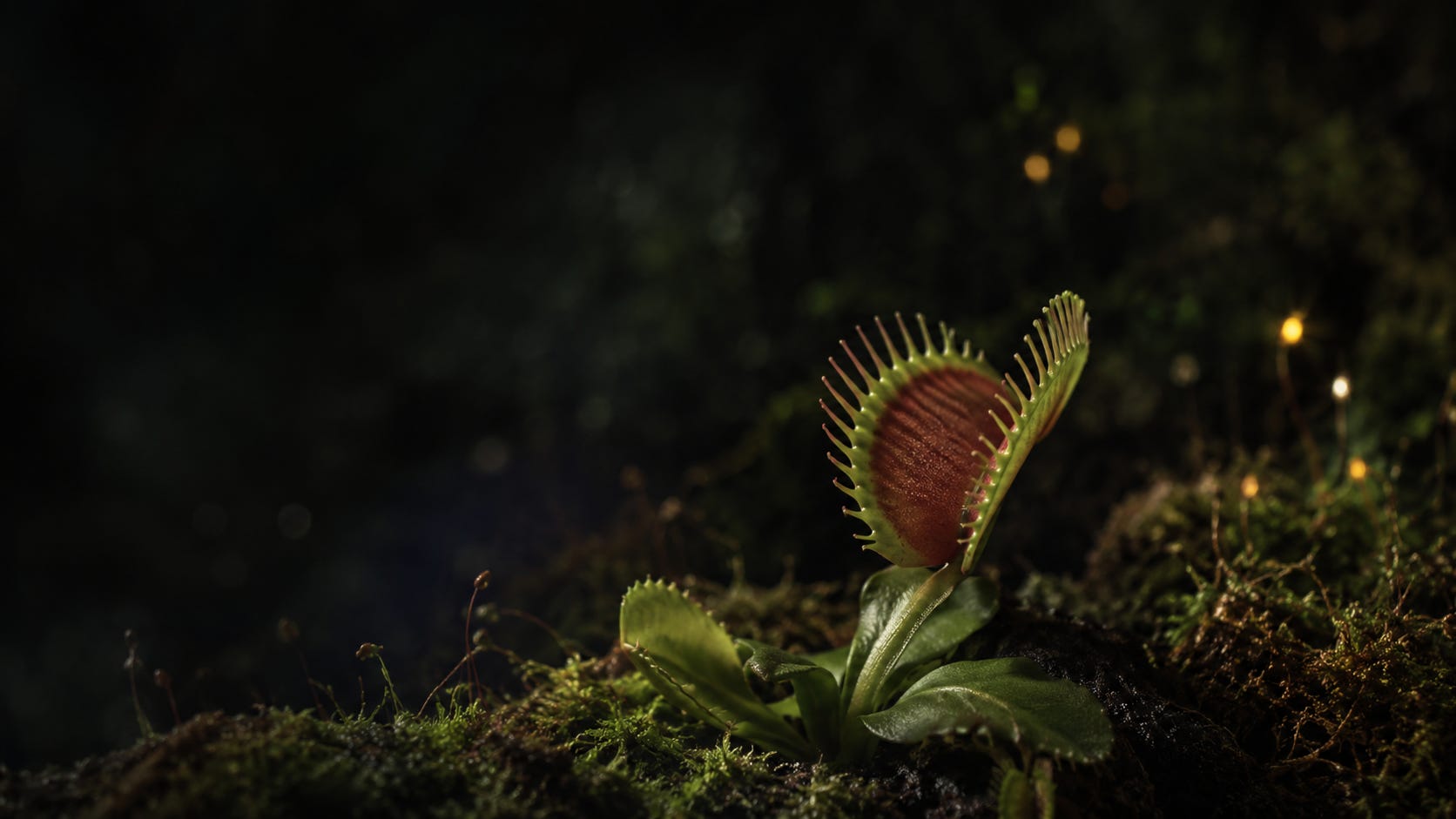
Put a Venus flytrap under ether and it stops hunting. The trap that would have snapped shut on a fly in a tenth of a second goes slack. Its electrical signals fall quiet. Leave it long enough, dose it right, and the plant simply… waits — until the anesthetic clears, and then it wakes, if wakes is the word, and starts counting touches on its trigger hairs again as though nothing happened.
The same molecules that switch off a surgical patient switch off a plant. This is not a metaphor. It is a laboratory result, and it has been sitting in the literature making people uncomfortable for years.
I trained as a physicist before I started telling stories, and I have never fully shaken the physicist’s bad habit of asking what a thing is made of. So when I read that anesthetics work on a flytrap that has no brain, no neurons, no synapses for them to act on, the question that arrived was not spiritual. It was mechanical. What, exactly, is the drug turning off?
There is a theory — unfashionable, ambitious, possibly wrong in the most interesting way a theory can be wrong — that has an answer.
Roger Penrose and Stuart Hameroff have spent thirty years arguing that consciousness does not live in the wiring diagram of the brain. It lives underneath it, in the cytoskeleton — in microtubules, the tiny protein scaffolds that hold every one of our cells in shape. Their claim, stripped of the mathematics, is that these structures sustain fragile quantum states, and that each time such a state collapses into a single outcome, something happens that we have no better word for than a moment of experience. Consciousness, on this view, is not a computation the brain performs. It is a sequence of collapses — forty a second, give or take — each one a frame in the film we mistake for a continuous self.
It is a strange and beautiful idea, and most of my former colleagues think it is wrong. The objection is almost boringly practical: the brain is warm and wet and loud, and quantum states hate warmth and wetness and noise. They fall apart — decohere — in fractions of a fraction of a second, far too fast, the critics say, to run a mind. For twenty-five years that objection has been the wall the theory keeps walking into.
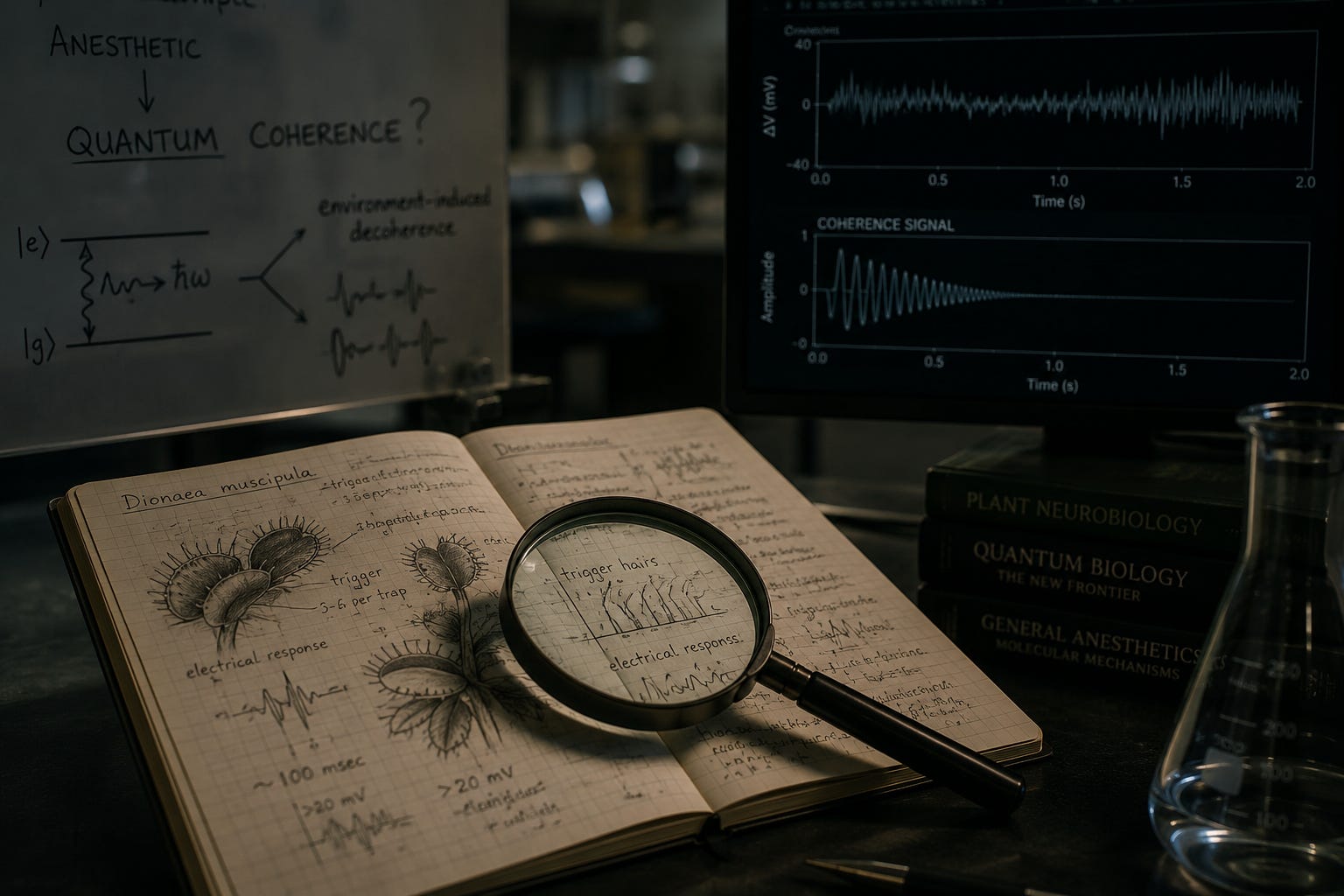
But here is the part that made me sit up. Microtubules are not a brain thing. They are a life thing. Every plant cell is packed with them, built from the same basic protein architecture, studded with the same aromatic rings the theory says do the quantum work. Which means that the cellular machinery the theory points to in us is present in the flytrap too. The drug does not know I have a brain. Whatever it is reaching for, it can reach into the plant as well.
So follow the logic where it wants to go. If consciousness is a gradient rather than a human trophy — if it thins out across the living world instead of switching cleanly on only in creatures with faces — then a plant is not nothing. A plant is somewhere on the scale.
The question is where. And here the theory says something far more interesting than the mystics do.
The mystic wants the plant to be a slow green person — patient, wise, feeling the seasons. The physics wants no such thing.
Because the thing that makes me a unified someone, on this theory, is not that I have quantum states. It is that my brain orchestrates them — binds enormous numbers of them into a single coordinated collapse, so that a whole moment happens at once, as one thing, behind one point of view. That binding is the expensive, evolved, brain-shaped part. It is the reason there is a me here to write this and a you there to doubt it.
A plant has none of that machinery. No neurons to synchronize. No gamma rhythm gathering the whole organism into a single now. What a plant has instead is slowness and dispersal — signals creeping root to leaf, cell to cell, with nothing anywhere pulling them into a center. A plant is built, precisely, not to have a center.
So the theory does not give you a wise old tree. It gives you something stranger and, I think, more honest: a forest of flickers. Experience scattered through the tissue in tiny uncoordinated grains — sensation, maybe, without a sensor; feeling without a feeler; a great many small lights and no one behind them, watching them all at once. Not a mind. A shimmer.
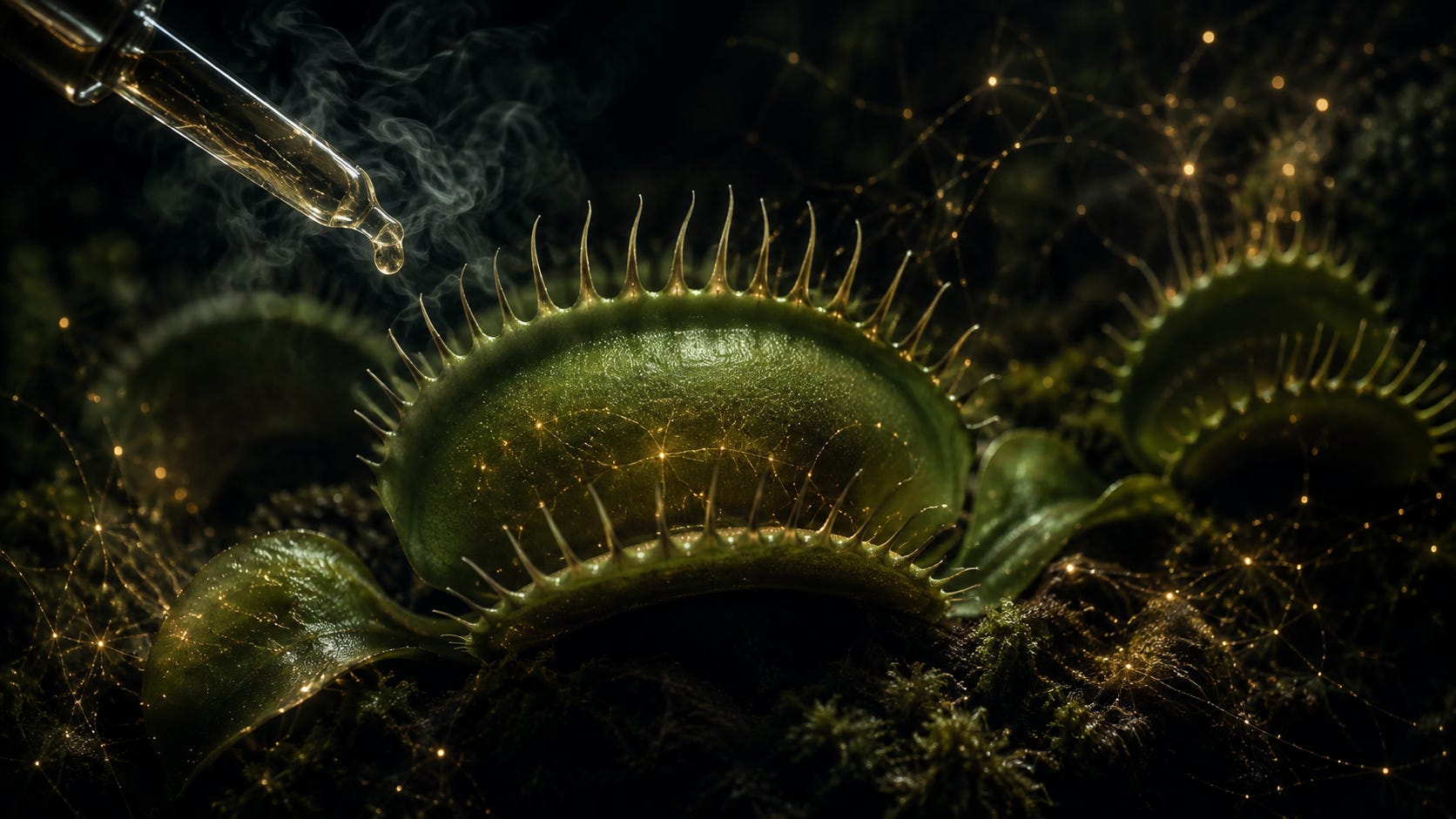
Is that consciousness? I don’t know. I’m not sure the word survives contact with the idea.
And now I have to be fair, because the most seductive piece of evidence is also the one most likely to mislead us.
Life is demonstrably quantum in at least one place, and it is the greenest place of all. Inside photosynthetic machinery, when a photon is caught, the packet of energy it becomes does not simply stumble blindly toward the machinery that will spend it. For a vanishing instant it seems to travel as a quantum thing — sampling many paths at once, finding the efficient one. Physicists detected this kind of coherence in 2007, and quantum biology suddenly seemed to have its flagship result. Here, at last, was proof: warm, wet, living matter playing the quantum game and winning.
I want it to mean what it seems to mean. It doesn’t — not for consciousness. The coherence in photosynthetic systems lasts femtoseconds and spans a microscopic structure. The coherence a mind would need must last milliseconds and span a brain — a trillion times longer, across the gulf between one protein and an entire organ. Photosynthesis doesn’t rescue the quantum theory of mind. It marks, in bright green, exactly how far that theory still has to walk. And even the original result got quieter with time; a decade of harder looking suggested nature was doing something more modest than we first, thrillingly, claimed.
Most of all: the light-catching in a leaf has nothing to do with feeling. It is plumbing. Gorgeous, efficient, quantum plumbing — but there is no more reason to think the exciton’s quantum walk feels like something than to think a copper wire does.
So here is where I land, and it is a stranger place than either the skeptic or the mystic wanted to leave me.
The leaf is quantum. The leaf is not awake. Both of these are, as far as we can tell, true — and holding them together is the whole task.
I care about this because of what it does to the word value.
We are generous, as a species, with things that seem to look back at us. We protect the animal with the eyes. We hesitate over the plant, the fungus, the reef, the soil, because nothing in them meets our gaze, and we have quietly decided that a thing with no inner life is a thing we may spend.
But a gradient theory of mind — even a speculative, embattled, probably-wrong one — puts a crack in that decision. It raises the possibility that the world is thick with experience that simply isn’t organized like ours: real, and everywhere, and headless. That there could be feeling with no one to own it. That the forest could be full of flickers and empty of faces, and be no less alive for it.
I don’t need the theory to be true to be changed by the question. I only need to admit I don’t know — and that not-knowing is already an argument for care. We are deciding the fate of the living world on the assumption that most of it is dark inside. What if we’re wrong? What if the dark is full of small lights?
The physics may never settle it. The flytrap, dosed and slack on the lab bench, is not going to tell us. But it stopped hunting when we gave it the drug we give ourselves — and I find I cannot un-know that.
Defend the forest anyway. Especially if it is only flickering.
Thank you for this. I’m confused by the thesis attributed to Penrose and Hameroff that “these structures sustain fragile quantum states, and that each time such a state collapses into a single outcome, something happens that we have no better word for than a moment of experience. Consciousness, on this view, is not a computation the brain performs. It is a sequence of collapses — forty a second, give or take — each one a frame in the film we mistake for a continuous self.” Any advice on how to understand the notions of fragile quantum state and quantum collapse? I have no clue what these ideas mean in ordinary English.
Beautiful article